
Operate your airport from airside to landside
Inventory, inspection and maintenance of all airport infrastructure —runway, taxiways, apron, visual aids, terminal, equipment— on a live map. Each asset with its status, its history and its evidence, ready for the aviation authority.
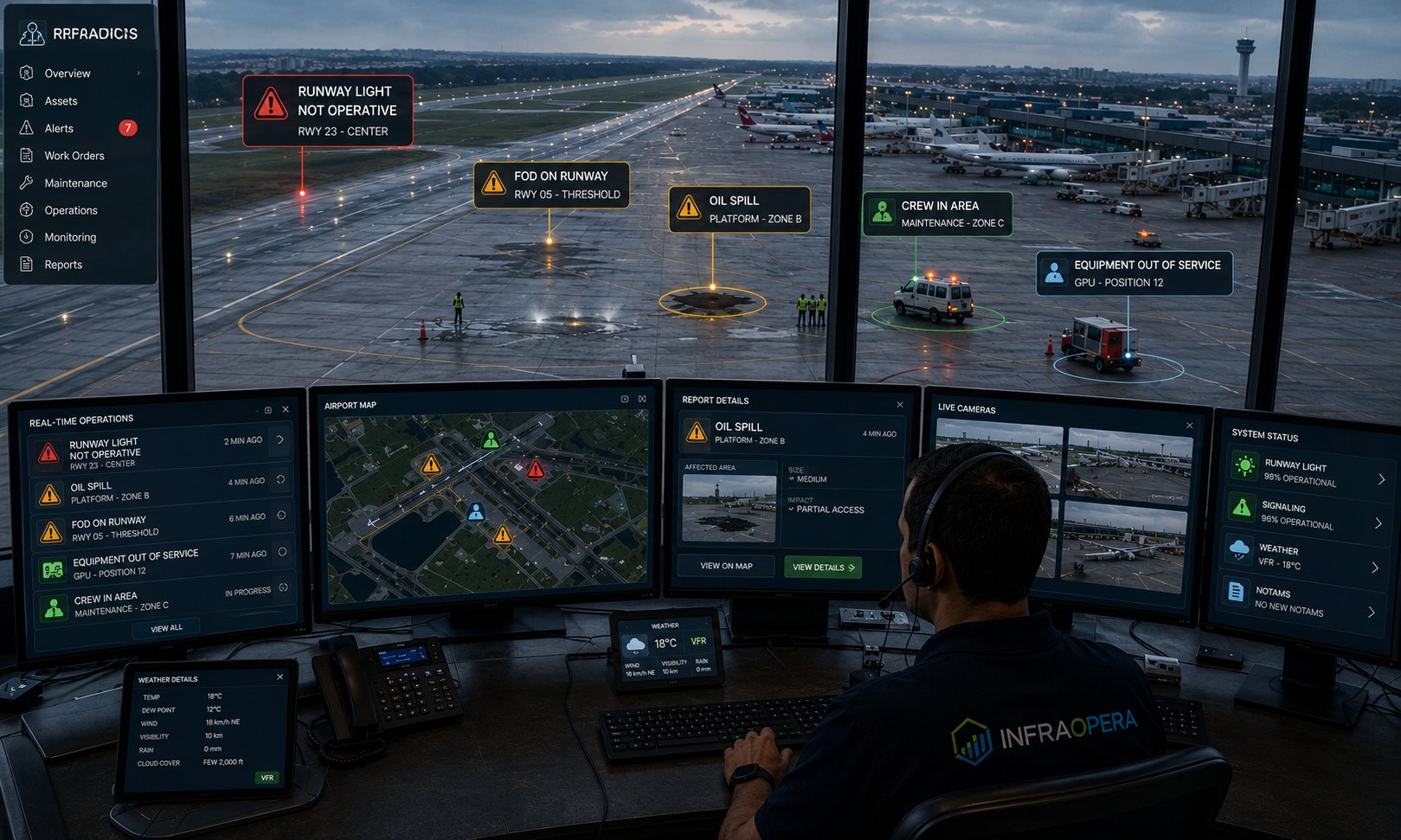
The airport is operated under pressure and blind
An airport operates under strict safety and regulatory demands, with critical assets spread out, and is often managed with fragmented information that turns into operational risk and audit findings:
The inventory lives in the team's memory
How many runway lights, signs, visual aids and equipment there are, where they are, when they were installed and under what warranty: that knowledge exists, scattered. With staff turnover, the critical data is lost.
Unverifiable inspections
Runway and apron inspections are mandatory, but without geolocated, dated evidence, that doesn't defend the operation before the aviation authority.
Operation with no field control
Did the contractor reach the right taxiway? What did they do? How long did it take? On the airside, chasing evidence without traceability is a safety risk, not just a cost.
Risk in operational safety audits
When the aviation authority audits, gathering the scattered inspection and maintenance evidence takes weeks and leaves gaps that compromise certification.
InfraOpera turns the airport into an operating system
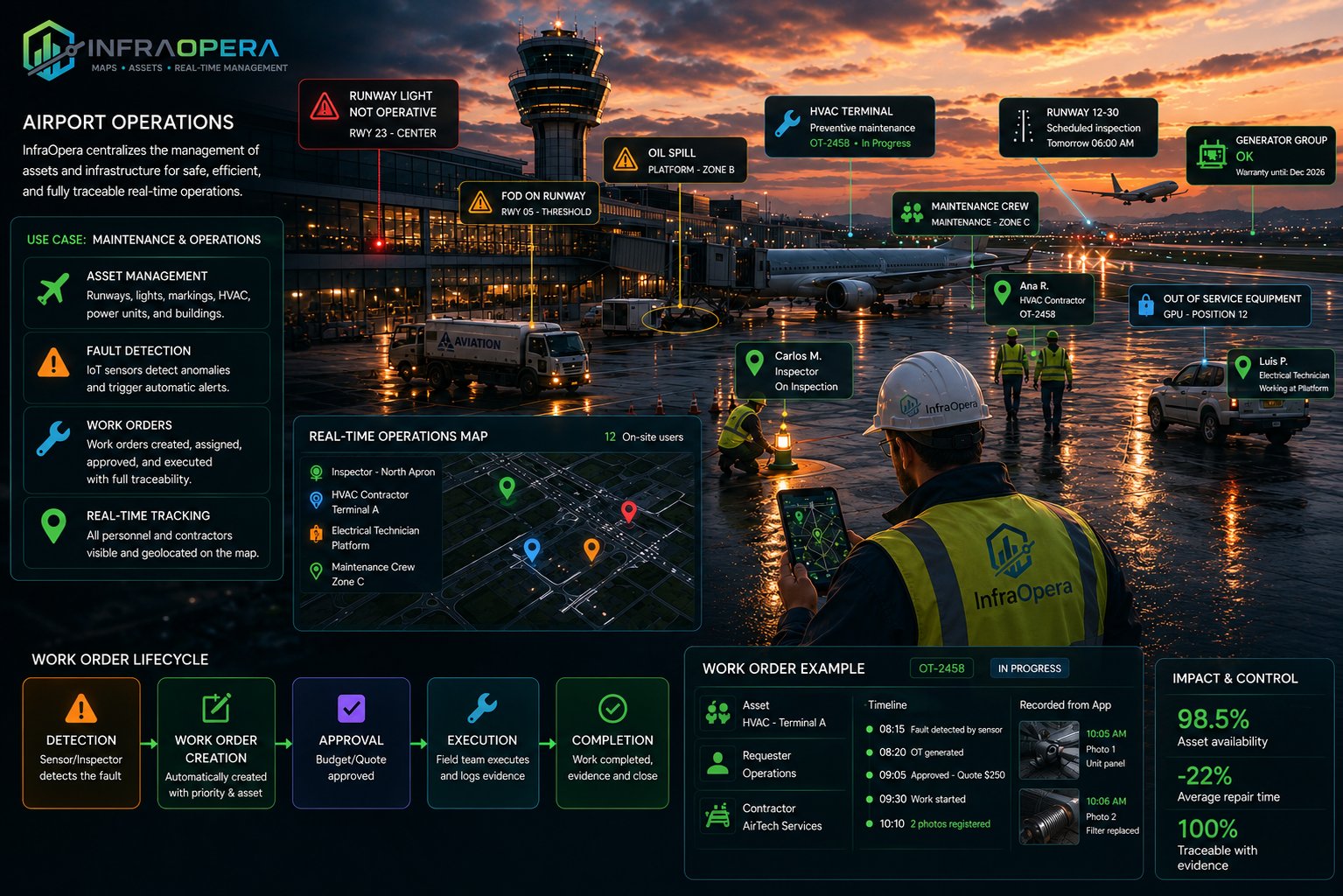
Each airport asset with geometry, attributes and status. Each inspection with location, evidence and person responsible. Each decision with measurable backing before the authority.
Georeferenced airport inventory
Each runway light, sign, visual aid, jet bridge and piece of equipment located on the map with its technical, contractual and warranty attributes.
Inspection with evidence
The inspector walks the runway, taxiways and apron, recording findings with a geolocated photo and status. Everything is tied to the asset and to a date that can't be altered.
Traceable maintenance
Each work order is born from a finding, is assigned, executed and closed with evidence. The complete history lives in the asset, ready for the authority.
Validated drone capture
Engineering-grade orthomosaics and models of the airside. A baseline of runway and apron, documenting their evolution and deterioration flight by flight.
Every asset in the airport
From the runway threshold to the last baggage carousel. All inventoried, located and with its maintenance history.
Airside
Runway, taxiways, apron
Visual aids
Runway lights, PAPI, signage
Terminal
HVAC, elevators, jet bridges, systems
Power generators
Generators, UPS, backup networks
Service equipment
ARFF, vehicles, ramp equipment
Security and fencing
Perimeter, access control
From finding to closeout, with evidence
A simple, traceable operating cycle, designed for the demands of airport operational safety.
Load the airport
You upload the infrastructure and assets, or capture them with a drone. The entire airport becomes live on the map.
Inspect and report
The inspector reports a finding from the map with exact location and photo. The incident is recorded and tied to the asset.
Assign with geofence
The work order is assigned to the team. On arrival at the zone —even on the airside— the geofence registers them. They execute and upload evidence.
Validate and archive
The supervisor approves with the evidence. The history stays in the asset, ready for the aviation authority.
An airport where no one on site is alone.
Apron staff, the inspector, the ramp team stop depending on a saturated radio. From their device they have a direct channel to report a finding, FOD, a spill or a situation. Each report reaches the operations center with exact location on the airside, in real time, and triggers the response the airport has defined.
Each report reaches whoever must respond
Living Airport is configured according to your airport's operational structure. You define the rule; the system routes each report to the right destination, with exact location and in real time:
- ⚠️ FOD or object on the runway Immediate alert to the operations control center for action on the airside.
- 🔥 Spill or emergency Notifies the Aircraft Rescue and Fire Fighting service (ARFF) and whoever the rule determines, with precise location.
- 🔧 Maintenance finding Reaches the team responsible for that zone or system, tied to the asset.
The system routes and documents. Verification and the response decision remain in your operation's hands — InfraOpera executes the rule you defined.
FOD on the airside
Staff report a foreign object from the site. The control center receives the exact location on the runway or taxiway and acts immediately. Operational safety doesn't wait.
Spill or emergency
An alert activates ARFF and the areas the rule determines, with precise location. The response is coordinated and recorded for the subsequent investigation.
Inspection finding
The inspector walking the airside reports what they see: a dead light, a crack, a deteriorated sign. The finding is tied to the asset and triggers the work order.
Coordination on site
All apron staff visible and geolocated on the map. The control center coordinates with real location, not with imprecise radio reports.
Every sensor, a defensible decision.
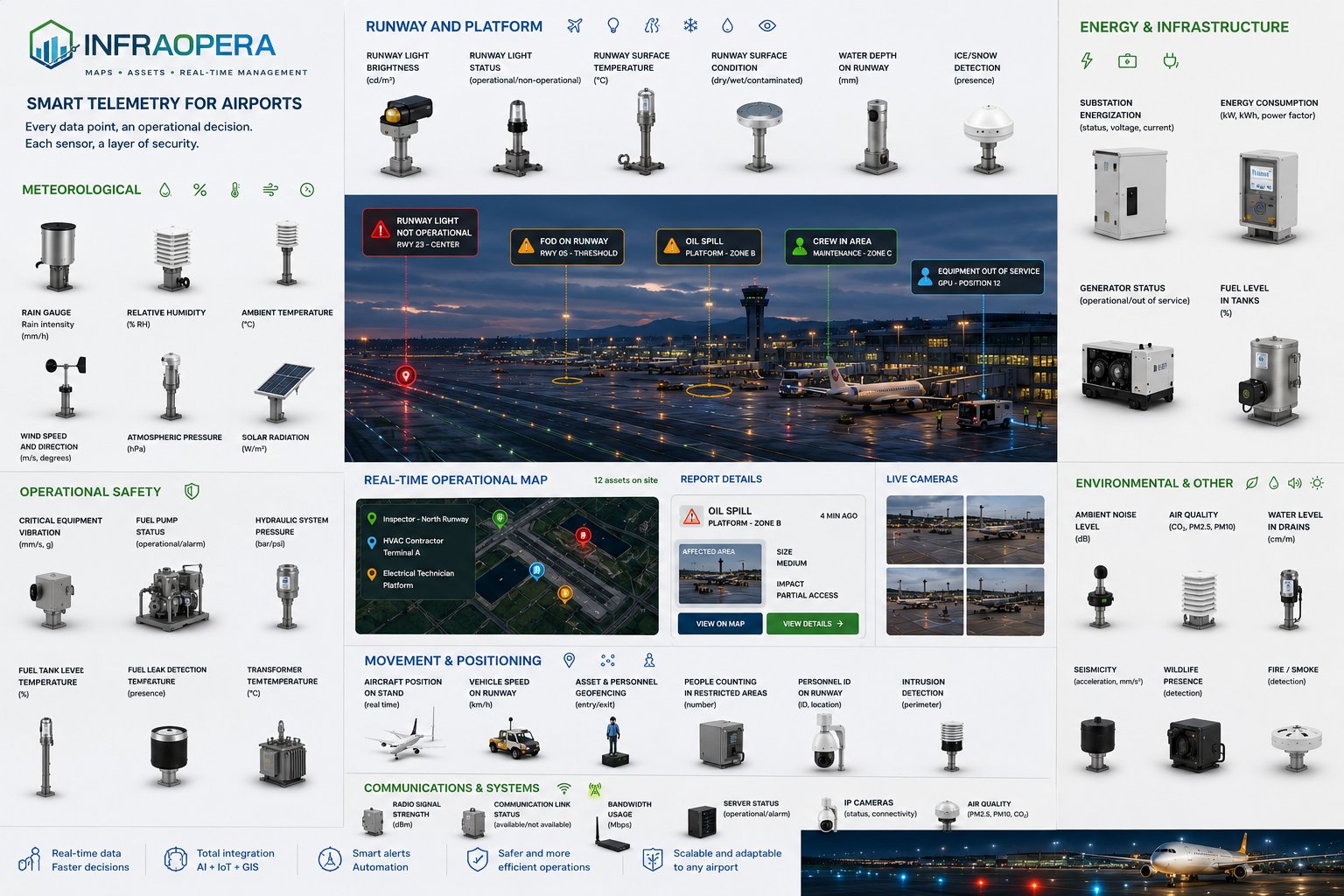
You decide what to measure and how you want to operate your airport. InfraOpera doesn't sell the hardware: it connects it. We identify in the market the open sensors your operation needs —weather, runway-condition, operational-safety, motion, power, environmental— and integrate them into the same map where your assets live. These are examples of what can be captured:
Support before the authority
Weather and runway-condition sensors record and seal the operational conditions, with dates. That history becomes the support to back operational decisions and reports before the aviation authority: traceable evidence of the conditions at any moment.
Operational safety
A vibration sensor on critical equipment —a power generator, a fuel pump— crosses the threshold you configured. InfraOpera generates the incident, creates an automatic geozone and triggers the response before the failure affects the operation.
Automatic operation
A weather station warns of conditions that affect the operation; a power sensor detects an anomaly in a generator; a level sensor monitors fuel. Each reading can generate a traceable work order, with the support of AI —audible or by message— that suggests action scenarios for the operator to decide.
Closeness to the operation
Telemetry doesn't just monitor: it coordinates. A critical weather condition or an event on the airside can be notified to the staff who are in the affected geozone, in real time, where timely information is safety.
Access control and identity on the airside, in real time
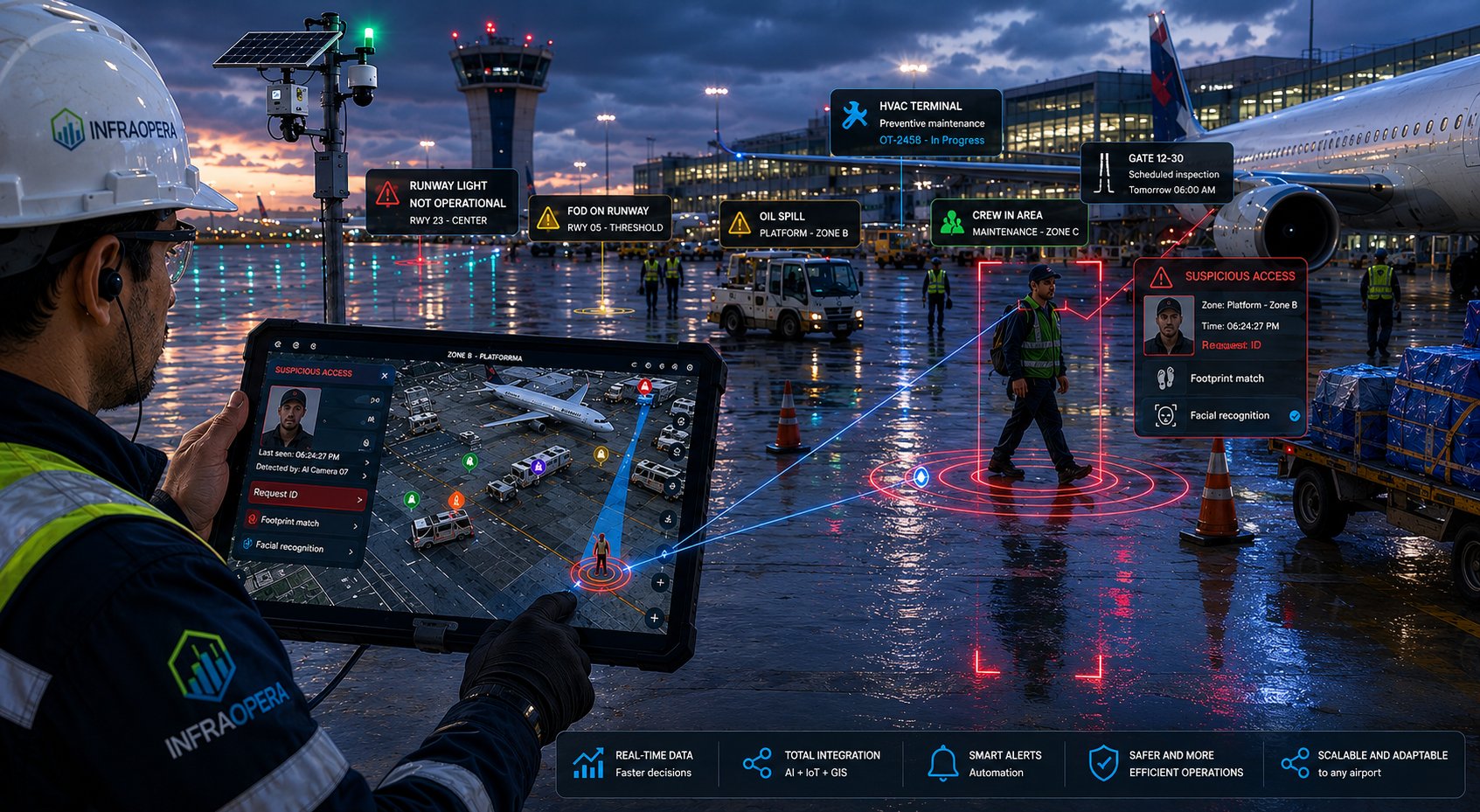
An RFID card opens a door, but doesn't confirm who went through it. InfraOpera can integrate access control and real-time tracking for every person in the airside operation, and trigger a security re-identification —by fingerprint and/or facial recognition— whenever you define it:
- 🔁 Re-ID by routine. The system asks a person, or everyone on the airside, for a periodic re-identification. Anyone who doesn't complete it is flagged as a suspicious access.
- 👁️ Re-ID under suspicion. If the control center sees someone in uniform whose presence doesn't add up, it can request an immediate re-identification from the screen —fingerprint, real-time photo and, if required, facial identification— instead of trusting the RFID.
- 🛠️ Tailored. It's designed with hardware available on the market, and the tracking and identity policies are configured per user for each project.
🔒 Privacy by design. InfraOpera does not routinely store each user's location history. The position is seen in real time (updated every 15 seconds) without being stored, and only while the person is inside the project's geofence. The capture of biometric data and its processing are defined and authorized according to the client's legal framework and policies.
What changes when you operate with InfraOpera
The backing of the airport's critical infrastructure, in one place
An airport is extremely high-value critical infrastructure under strict regulation. InfraOpera doesn't just give you operational control: it turns the infrastructure into a secure digital record, indexed and instantly searchable. It's not just operation — it's verifiable backing before the authority and certification.
The airport's memory, not people's
Knowledge of the critical asset stops leaving with turnover. It stays in the organization, backed up and available.
Ready for the aviation authority
Each inspection and maintenance with its evidence, date and person responsible. What the operational safety audit asks for in weeks, you deliver documented.
Backing for certification
The real status of the infrastructure, supported and auditable. Backing that sustains safe operation and protects the airport's certification.
Your airport, under control
We set up the initial inventory, the operational map and a real case running. No vague promises: operational control from the first month.